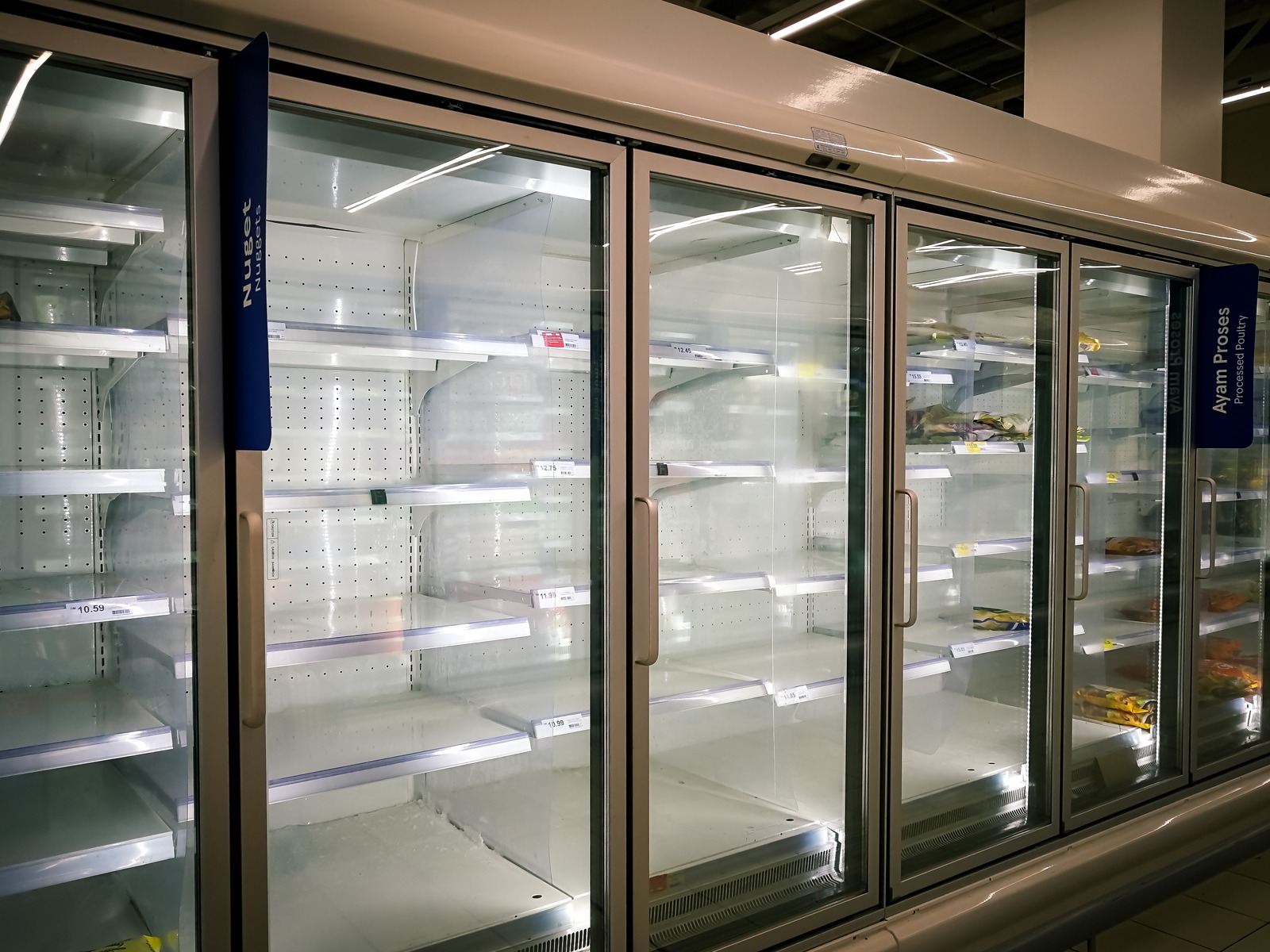
At around 4 am on 2 November 2026, someone remotely changed the settings of the refrigerated display cabinets in several Sicilian supermarkets. By opening time the cabinets were outside their permitted temperature range and the stock had to be disposed of. The operator of four stores, three in Catania and one in Palermo, confirmed an attack on the remote management system for its freezer cabinets. For supermarket cybersecurity the incident was unusual: no servers were encrypted and nobody claimed responsibility, yet the losses came in spoiled stock.
According to Euronews, on the same night around a hundred supermarkets in Sweden, Belgium, Luxembourg, Estonia and Ireland suffered a similar attack, with temperatures inside the refrigeration units pushed above 50°C. On 12 October another intrusion had already hit major French supermarket chains. In Italy the specialist cybercrime police are investigating where the attacks came from and whether they are linked to the incidents elsewhere in Europe. The attack hit the cabinets’ remote management system and spoiled the stock. How the attackers gained access remains unclear.
Why does supermarket cybersecurity extend to refrigeration?
Because refrigeration plants, cabinet controllers, tills and cameras are networked devices, often managed by outside contractors and reachable remotely.
A medium-sized supermarket may have more networked devices than its IT asset register shows. The refrigeration plant has a controller that manages compressors and defrost cycles. Each cabinet has its own electronic board, and the refrigeration contractor monitors these devices remotely, receives alerts and adjusts settings without visiting the site. The same network often carries tills, scales linked to the retail management system, CCTV cameras and recorders, access control, digital signage and customer Wi-Fi.
Refrigeration plants and cabinet controllers fall within operational technology, or OT. They drive physical processes, stay in service for many years and are rarely updated. Tills and office PCs are conventional IT, yet they often share the same network. In a food store, maintaining the cold chain is one of the most critical operational requirements, and that is where a gap in supermarket cybersecurity causes immediate losses.
One network for tills, refrigeration and offices
In many stores the tills, the refrigeration systems and the office PCs share the same network. Anyone who gets in through a vulnerable device can reach the others. Likewise, a PC compromised through phishing may be able to access the refrigeration controls. Segmenting the OT network from the IT network reduces the risk of an attack spreading between segments.
Every contractor with its own way in
The refrigeration engineer uses one remote-access tool, the camera installer an app, the till software supplier a third tool. These remote-access accounts often stay enabled between maintenance visits. The same credentials are reused across several stores in the chain, and sometimes they are still the factory defaults. In some cases the contractor also installs its own router with a data SIM, which connects the refrigeration system directly to the internet, bypassing the company firewall.
Equipment missing from the asset register
The maintenance contract usually covers compressors and refrigerant circuits, but not necessarily the controller software. Meanwhile, the IT department may not even know that the device exists: it neither updates it nor monitors its traffic. Reporting by ItaliaOggi on the November attacks points precisely to ageing devices that lack security patches and can no longer receive firmware updates.
When refrigeration fails overnight: stock, store operations and liability
A gap in supermarket cybersecurity turns into three separate costs. The first is stock. When a freezer cabinet stays outside its permitted temperature range for an extended period, the stock has to be withdrawn from sale, and the store manager decides under the food safety plan. The EU regulation on the hygiene of foodstuffs states that the cold chain is not to be interrupted (Regulation (EC) No 852/2004, Annex II, Chapter IX).
Then come store operations. When the store opens, staff may have to empty the freezer cabinets, departments stay closed until an engineer arrives, and the morning goes on documenting losses and disposing of affected stock instead of serving customers. If the attack hits several stores in the chain on the same night, the available maintenance engineers cannot attend every site promptly.
The third cost concerns liability. Responsibility for food safety remains with the food business operator, even when the cause is unauthorised access to equipment managed by an external contractor. The ability to recover losses depends on maintenance contracts that rarely define cybersecurity responsibilities. When underwriting or renewing cyber policies, insurers ask about remote-access controls and backup arrangements. Retail chains and wholesalers subject to NIS2, as well as those supplying businesses within its scope, also receive the same questions through customer questionnaires.
Beyond supermarkets, the same ungoverned remote access
Refrigeration contractors need remote access to maintain equipment, but those connections often stay enabled long after the work ends. In the assessments Aesir conducts before taking on responsibility for a company’s IT, the same pattern appears well beyond food retail. During an assessment at a service-sector company in summer 2026, the external technician generally accessed the network with remote-support software. As the manager explained, he entered the network ‘with permission to do whatever he needs to do’. At a second company an employee connected from outside with free remote-access software, later replaced by another tool installed a week before the assessment. Two colleagues used the VPN, but nobody in the office knew how it was configured.
Neither company was a supermarket and neither had suffered an incident. In both, however, external access had been set up for convenience and never reviewed: the same checks apply to the connections refrigeration contractors use. ‘Always-on remote access and ageing equipment: that is where the attacks on supermarket fridges began’, wrote Jacopo del Campo, CTO at Aesir, in the internal brief he prepared on 7 November.
One channel for technicians and contractors
In situations like these, Aesir recommends routing all remote access through a single controlled entry point: a VPN protected by multi-factor authentication for employees, and a privileged access management platform for engineers and contractors. The platform lets the engineer start a session without knowing the device’s underlying credentials. Access lasts for the duration of the job and the session is recorded. When a contractor is replaced, its access is revoked centrally and a check confirms that no unauthorised remote-access software remains installed.
Insight. In November the attacks hit remote management, while the way in has not yet been established. Meanwhile, the useful check for a store manager concerns the outsiders who could alter freezer cabinet settings tonight and the connections they would use.
Retail security: a practical checklist
The following checks are the starting point for supermarket cybersecurity, in a single store and across a multi-site chain alike:
- record every connected device, from the refrigeration plant to the cabinet controllers and from the tills to the cameras, with model, software version and the contractor that manages it;
- identify which devices are directly accessible from the public internet, and close every direct exposure;
- replace factory credentials and any credentials shared across several stores;
- split the network into separate segments for tills, refrigeration, cameras, offices and customer Wi-Fi, with written rules for traffic between segments;
- move every contractor onto a single remote-access channel, with multi-factor authentication, time-limited authorisation and session recording, and remove remote-access tools installed without approval;
- require maintenance contracts to name the authorised engineers, define responsibilities for firmware updates and set out incident-reporting obligations;
- send temperature alerts to an on-call contact overnight, and periodically check for unauthorised changes to temperature setpoints;
- keep copies of refrigeration and till configurations, together with a written procedure for stock affected by temperature excursions, setting out who decides and what must be recorded.
Store security: who manages what
The table summarises the main types of equipment found in a supermarket, who usually manages them and the first measure to take.
| Equipment | Usually managed by | Typical risk | First measure |
|---|---|---|---|
| Refrigeration plant and cabinet controllers | Refrigeration contractor | Internet-exposed remote-management interface, factory passwords | Dedicated network and contractor access through a single channel |
| Tills and scales | Till software supplier | Same network as the offices, postponed updates | Separate segment and updates scheduled outside opening hours |
| CCTV cameras and recording equipment | Security installer | App access with shared credentials | Individual credentials and a separate network |
| Router with a data SIM | Refrigeration contractor | An unmonitored access path that bypasses the company firewall | Add the router to the asset register and close exposed ports |
| Office and store PCs | IT department | Phishing and unauthorised remote-access tools | Endpoint protection and control of installed applications |
Aesir’s role in store security
Aesir Srl works as an MSP and MSSP within the same contractual scope: whoever runs the network and workstations also watches over their security. Contractor access rules, network segmentation and the firewall therefore sit with a single point of contact, who sets the rules and checks they are followed. For supermarket cybersecurity, this replaces the separate rules that refrigeration engineers, installers and IT providers each manage on their own.
At a food plant supported by Aesir, for example, the VPN accepts only Italian IP addresses. Each new authorisation requires the department head to take written responsibility for it. At a manufacturing group, administrator privileges are restored only after a recorded approval.
We are a Fortinet partner for firewalls and network segmentation. For equipment that cannot run antivirus software we use passive network monitoring, which identifies the devices active on the network and flags anomalous traffic without interfering with how they work. Security alerts are passed to a managed detection and response (MDR) service, with analysts providing overnight and weekend coverage. Immutable backups preserve system configurations, till records and the data held in management systems: with immutability enabled, not even administrator credentials can delete them before the retention period ends. The article on backup and disaster recovery explains how to test restoration before an incident occurs.
Aesir serves customers across Italy and holds ISO 9001, 27001, 27017 and 27018 certifications, with voluntary alignment to NIS2. Its own Tier IV data centres are in the European Union, with replication.
Supermarket cybersecurity: questions from store managers
Can the refrigeration contractor keep permanent access?
Permanent access is best avoided. Access is granted for the maintenance window, protected by multi-factor authentication and recorded, then revoked when the work is complete; temperature alerts can still reach the contractor without an inbound connection that is always open.
Are a firewall and antivirus enough to protect a supermarket?
They help protect the IT network and user workstations. Cabinet controllers, video recorders and some till terminals cannot run antivirus software, and therefore require network segmentation, controlled access and traffic monitoring.
Where should a chain with many stores begin?
A pilot store provides the starting point, with an asset inventory, a review of external connections and a documented network layout. Once verified, the measures are adapted to the infrastructure of the other stores. The work starts with those that have the oldest equipment.
Let’s talk
The November attacks hit refrigerated cabinets, but unprotected remote connections also expose tills, cameras and warehouse cold rooms. Supermarket cybersecurity starts with a list of connected equipment and of the remote access still enabled. If you would like to explore the subject or assess the situation in your own company, you can fill in the form at the bottom of this page or write to support@aesir-tech.it: we will arrange a free consultation and start from your numbers.